


Radio Astronomer Focuses on Antenna Design
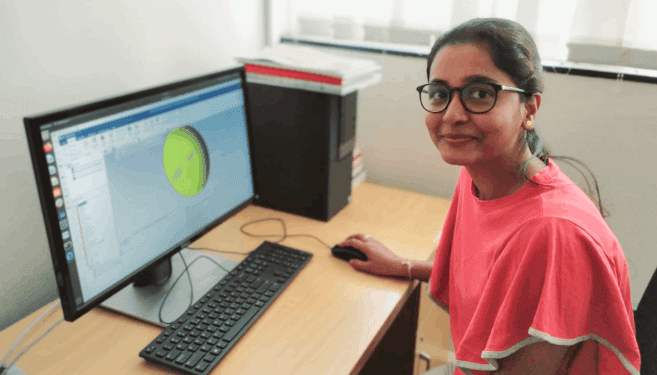
Research that focused on the design, optimisation and characterisation of a wideband dual-polarised feed antenna for the HIRAX (Hydrogen Intensity and Real-time Analysis eXperiment) radio telescope secured Dr Sindhu Gaddam a PhD in Mathematics from the University of KwaZulu-Natal (UKZN).
Gaddam, who was supervised by Professor Kavilan Moodley and Professor Dirk de Villiers, pursued her PhD at UKZN because of a unique and exciting opportunity: “My main motivation was the chance to work on the HIRAX project, particularly in radio telescope antenna design, which aligns closely with my research interests,” she said.
“Receiving the opportunity and funding genuinely excited and motivated me, as this is an area I have always wanted to explore.” She added that with UKZN’s good laboratory and computational facilities, she felt it was an ideal place to pursue her PhD.
Gaddam’s research addressed a highly specialised yet crucial component of the radio telescope: “My PhD work focused on the feed antenna design for the HIRAX radio telescope,” she explained. “The feed is the first stage of the telescope’s receiver system and picks up radio signals directly from space, playing a crucial role in its overall performance.”
“Designing it is very challenging because these cosmic radio signals are extremely weak, and the antenna must be highly sensitive.”
“By improving its sensitivity, my work helps scientists detect these faint signals more accurately and gain a better understanding of how the Universe has evolved from its origins to the present day,” said Gaddam.
“Even small improvements in the antenna’s sensitivity can make a meaningful difference in the data collected, helping us better understand the universe and supporting ongoing research in radio astronomy.”
Her thesis is titled: ‘Design, Optimisation and Characterisation of a Wideband Dual Polarised Feed Antenna for the HIRAX Radio Telescope’.
Gaddam’s path into the field of radio astronomy was shaped by her long-standing interests in both engineering and astronomy. “I have always been interested in electronics, which led me to study Electronics and Communication Engineering and later specialise in RF (Radio Frequency) and microwave engineering,” she said. “I also had a strong interest in astronomy and cosmology, though I didn’t have the opportunity to explore these earlier.”
The opportunity came when she worked as a research assistant on India’s SARAS (Shaped Antenna measurement of the background Radio Spectrum 3) radio telescope project. “This gave me the opportunity to combine my engineering background with my passion for astronomy and cosmology, which inspired me to pursue a PhD in radio astronomy and ultimately join the HIRAX project.”
Looking ahead, Gaddam plans to pursue a postdoctoral research fellowship at UKZN funded by a National Research Foundation (NRF) grant under the Swiss-South Africa Lead Agency Programme. “I then hope to continue in radio astronomy as a research scientist, focusing on designing advanced antenna and receiver systems and also contributing to data analysis in cosmology.”
Gaddam credited the people who supported her throughout her academic journey. “First and foremost, I am deeply grateful to my family for their unwavering encouragement and support,” she said. She also acknowledged her supervisors and mentors, adding that Moodley and de Villiers provided “mentorship, encouragement and guidance that have been invaluable in helping me navigate challenges, stay motivated and reach this milestone.”
Outside of her academic work, Gaddam, who is originally from Hyderabad in India, enjoys reading, watching documentaries, singing, dancing and cooking. “I particularly enjoy perfecting dishes, especially making Hyderabadi Dum Biryani, which brings me joy during stressful times,” she shared.
Reflecting on her PhD experience, Gaddam emphasised resilience. “Pursuing my PhD came with many challenges, and there were times when it felt extremely difficult to keep going. These experiences have taught me to stay focused and keep moving forward. Every step, no matter how small, counts.”
Words: Sally Frost
Photograph: Supplied
Original article: https://ndabaonline.ukzn.ac.za/UkzndabaStory/volume-14-issue-18-aes-graduation-special-edition-2/radio-astronomer-focuses-on-antenna-design
Inspiring Greatness
- UKZN Home
- Library
- Vacancies
- Directions
- Student Email
- Staff Email
- Telephone Directory
- Tenders
- Directory of Experts
© University of KwaZulu-Natal: All Rights Reserved