Mr Keshav Bechoo, who graduated with a master’s degree, has always been fascinated by the universe and how it works.
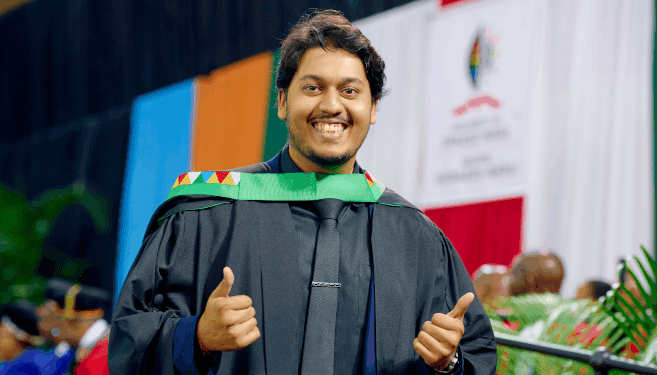


Mr Keshav Bechoo, who graduated with a master’s degree, has always been fascinated by the universe and how it works.
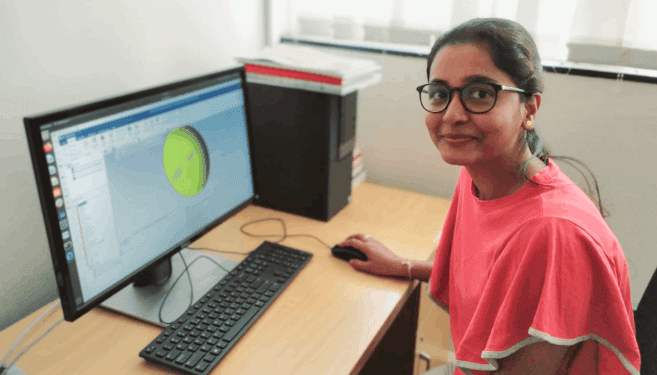
Research that focused on the design, optimisation and characterisation of a wideband dual-polarised feed antenna for the HIRAX (Hydrogen Intensity and Real-time Analysis eXperiment) radio telescope secured Dr Sindhu Gaddam a PhD in Mathematics from the University of KwaZulu-Natal (UKZN).
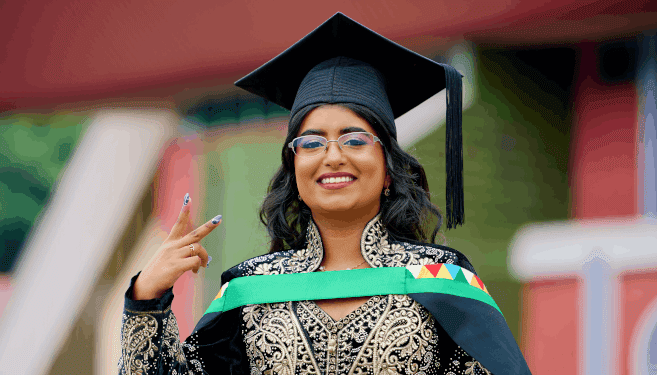
Master of Science (MSc) degree graduate Ms Tasmiya Papiah is already making meaningful contributions to South Africa’s growing presence in cutting-edge astrophysics research.
Intellectual curiosity and a desire to contribute meaningfully to understanding the universe were the driving forces behind Mickalan Subramoney’s journey towards a Master’s degree at the University of KwaZulu-Natal (UKZN).
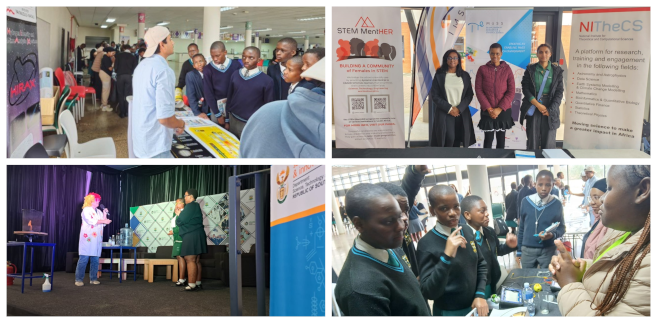
UKZN was on show at South Africa’s National Science Week (NSW) 2025, contributing to an exciting programme of science engagement activities organised by the Department of Science, Technology and Innovation (DSTI).
The event was hosted at the Anton Lembede Mathematics, Science and Technology (MST) Academy in Durban.

The Vera C. Rubin Observatory located in Chile, is unique in terms of its mirror design, camera sensitivity, telescope speed and computing infrastructure.
It is set to revolutionise understanding of the universe with its 8.4-metre Simonyi telescope which will allow it to scan the entire southern sky about every three nights.
For this reason, the Legacy Survey of Space and Time (LSST) programme was launched. It is a survey project aiming to map the entire visible southern sky in detail over a ten-year period.
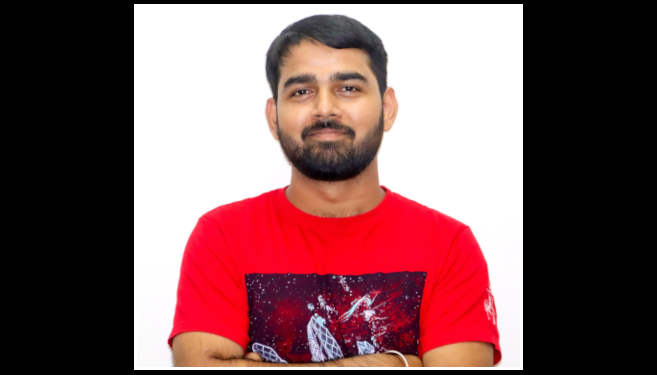
Dr Ajith Sampath received a PhD in Mathematics for his ground-breaking research into the complex instrumentation challenges of next-generation radio telescopes.
Supervised by Professor Kavilan Moodley, Sampath’s thesis titled: ‘Beam Characterisation and Foreground Removal for Intensity Mapping Experiments’, represents a major contribution to radio astronomy and cosmology.
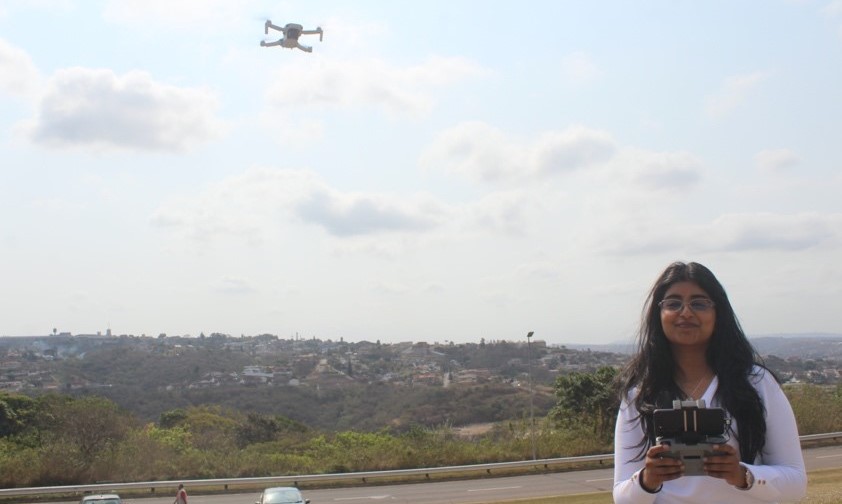
Breaking the glass ceiling is a phrase Ms Tasmiya Papiah is no stranger to! Currently completing her master’s degree under the supervision of Professor Kavilan Moodley and co-supervision of Dr Anthony Walters, Papiah’s research is focused on the analysis of drone beam mapping data from the HIRAX testbed array project.